Discuss Cooking Community

Go Back   Discuss Cooking Community > General Cooking Forums > Cookware and Accessories > Cookware


Reply
 
Thread Tools Display Modes
Old 10-04-2004, 12:43 AM   #11
SierraCook
Certified Master Chef
 
SierraCook's Avatar
Profile:  Location: Sierra Valley, Northern California, USA
Posts: 5,093
Images: 4
Send a message via Yahoo to SierraCook
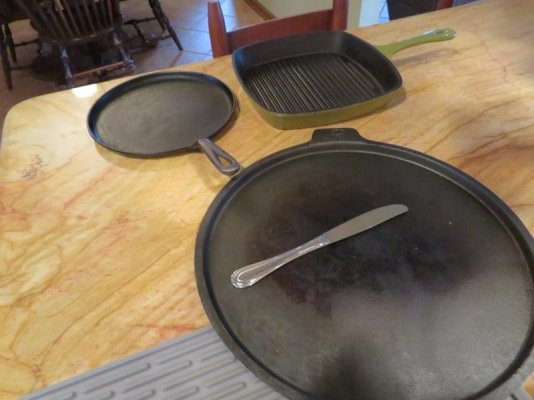
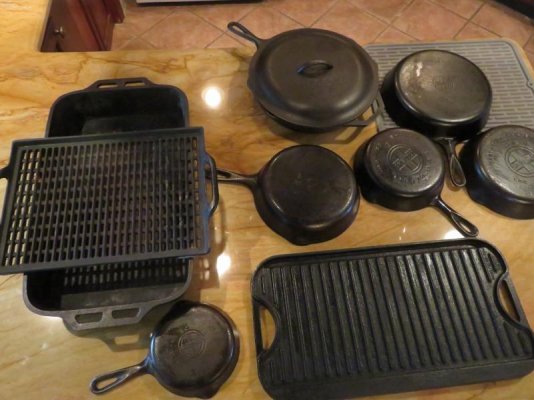
I love my cast iron ware also. I have ten and eight inch skillets, a grill pan, griddle, and a Dutch oven. I love to make frittatas in cast iron, they come out so good. I can remember my mom making shredded hash browns from scratch in her cast iron skillet when I was a kid. We always used to take that skillet with us camping. All of mine are also "Lodge" brand.
__________________
We don't stop playing because we grow old; we grow old because we stop playing. --George Bernard Shaw
SierraCook is online now   Reply With Quote
Old 10-04-2004, 10:30 PM   #12
Michael in FtW
Certified Master Chef
 
Michael in FtW's Avatar
Site Moderator
Profile:  Location: Fort Worth, TX
Posts: 5,668
Quote:
Originally Posted by Bangbang
I always wondered why they are made of Iron.
Probably for two reasons - ecominics and durability. Iron was cheap and more durable than copper. It became popular somewhere in 1600-1700 after an Englishman adapted the Dutch "sand mold casting" method used for brass to iron - hence "cast iron". Which "might" be where Dutch oven's got their name. Low cost and durability surely made it attractive to pioneers moving West.

Aluminum didn't really exist until about 1825 - and I don't know about when it became affordable or used for cookware.
Michael in FtW is offline   Reply With Quote
Old 07-08-2005, 07:32 PM   #13
Robo410
Certified Executive Chef
Profile:  Location: SE Pennsylvania
Posts: 3,302
Images: 10
aluminum needed electricity to refine economically so it became a 20th century metal. It also has to be heavy cast and polished( like magnalite) or hard anodysed (acid electro dipped) to make it non reactive, and all that made it more expensive than cast iron.
Robo410 is offline   Reply With Quote
Old 07-09-2005, 11:25 AM   #14
Goodweed of the North
Certified Executive Chef
 
Goodweed of the North's Avatar
Profile:  Location: USA,Michigan
Posts: 3,870
Images: 1
Quote:
Originally Posted by Robo410
aluminum needed electricity to refine economically so it became a 20th century metal. It also has to be heavy cast and polished( like magnalite) or hard anodysed (acid electro dipped) to make it non reactive, and all that made it more expensive than cast iron.
Anodised is a process that confuses me. Most references to the process involve a type of electrical deposition of material to the surface strata of the base metal. And anodise certainly could come from anode, the electricall positive portion of the circuit. Gold plating uses a similar technique, using a chemical to disolve the gold, which is used as the cathode, or emmiter, and the base metal used as the cathode. As electrons flow from the cathode to the anode, the gold molecules are deposited on the base metal and become molecularly joined to that metal.

What confuses me about the process is personal experience. I worked for Lockheed Missiles & Space, on a contract to overhaul one of the U.S. Navy's Deep Submersible Rescue Vehicle (D.S.R.V). When the electronics portion of the project was completed, I was sent to perform corrosion control on various hull and structural componants. Part of that control was the anodization of aluminum parts, followed by painting with epoxy primers and paints. The anodizing was accomplished by disolving a powder in ordinary fresh water, and then painting the aluminum with the resultant solution. It changed the aluminum color and created a hard-anodized finish that resisted salt water corrosion. The paint was applied to add further protection from the elements. No electricity was used in the process, except to power the compressor for the paint guns, grinders, etc.

Now I know this has nothing to do with cooking, but is merely the ramblings of a curious engineering type. I would hypothesize that there is both an electro-chemical technique, and simply a chemical technique. After all, it is by electrical eddy currents that base metals corrode in the first place, supplied by hte electrical properties of dissimilar metals, oxygen and the prescence of either an acidic or alkaline electrolyte (think battery).

Seeeeeya; Goodweed of the North
__________________
"There is no success outside the home that justifies failure within the home."
Goodweed of the North is offline   Reply With Quote
Old 09-26-2007, 11:22 AM   #15
keltin
Banned
 
keltin's Avatar
Profile:  Location: Down South in Alabama
Posts: 2,285
Send a message via AIM to keltin
Unreal! I was curious as to what a “heat ring” is for on older cast iron piece, and Google led me here. DC has it all!!!!

Thanks for posting that link Michael!
keltin is offline   Reply With Quote
Reply

Thread Tools
Display Modes

Posting Rules
You may not post new threads
You may not post replies
You may not post attachments
You may not edit your posts

BB code is On
Smilies are On
[IMG] code is On
HTML code is Off
Trackbacks are Off
Pingbacks are Off
Refbacks are Off
Forum Jump

Similar Threads
Thread Thread Starter Forum Replies Last Post
Cast Iron Use and Care Ten_Spoons Cookware 35 11-11-2008 01:49 PM
Cast Iron Hibachi lutzzz Grills & Smokers 19 08-23-2008 12:52 PM
Electric Cast Iron Skillet? okdeb Appliances 11 12-24-2007 03:34 PM
Cast Iron cookware LisaBradley Cookware and Accessories 15 05-28-2004 09:55 PM


All times are GMT -5. The time now is 02:34 PM.

Other Social Knowledge forum communities:
Cooking Forum - Sailing Forum - Early Retirement - Airstream Trailer - Aquarium Forum - Royal Forum - Book Forum - Volkswagen Touareg Forum - Jeep Wrangler Forum - Whitewater Kayaking & Rafting Forum - Fiberglass RV Forum - RV Forum - Truck Conversion - U2 Music Forum
Social Knowledge Networks
Powered by vBulletin® Version 3.7.2
Copyright ©2000 - 2008, Jelsoft Enterprises Ltd.
Content Relevant URLs by vBSEO 3.2.0


eXTReMe Tracker